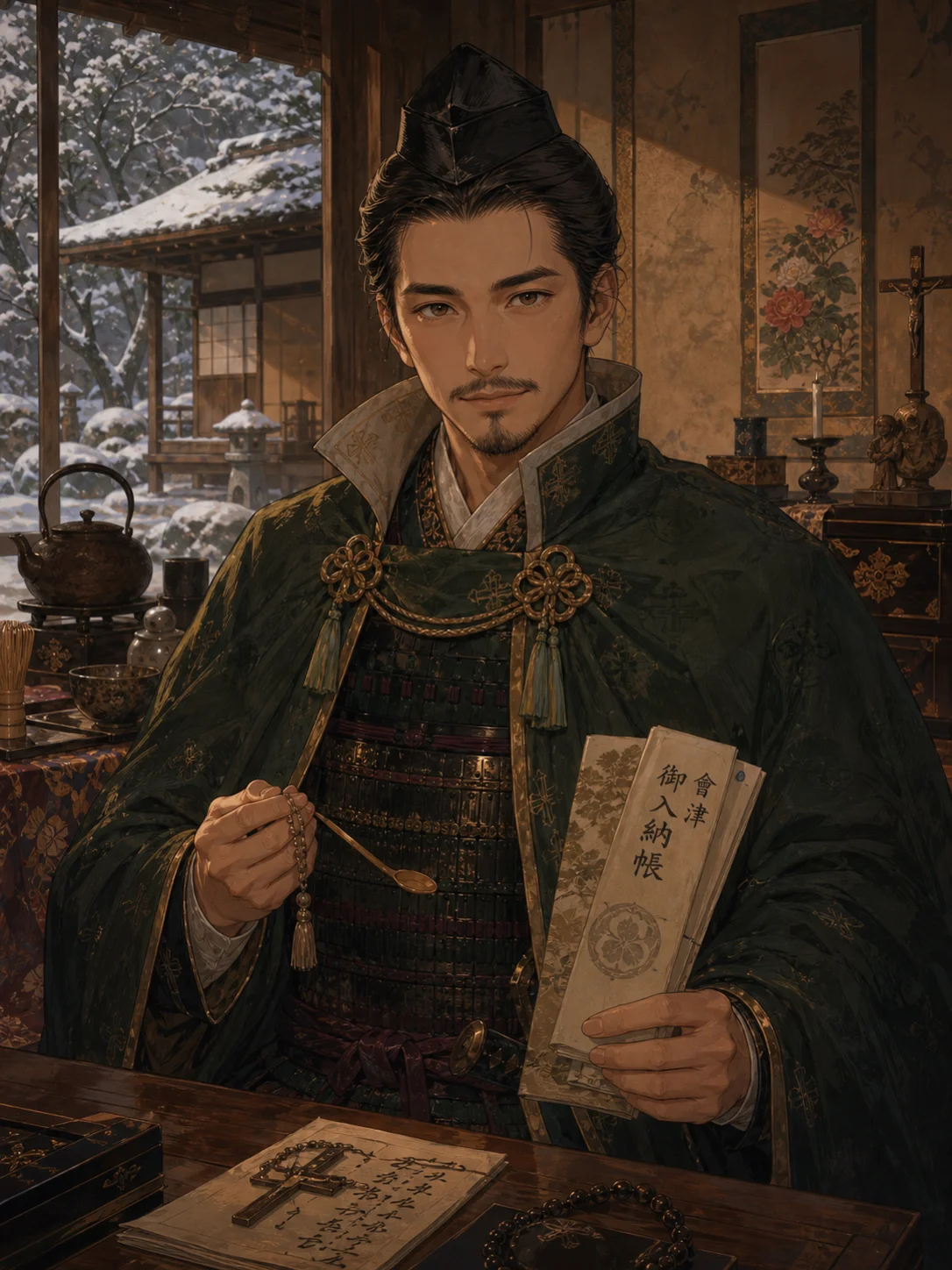
Gamō Ujisato
“At thirteen he was a hostage to the Oda, yet Nobunaga recognized his gifts and welcomed him as a son-in-law. A master of strategy, tea, and faith, his talent led Hideyoshi to send him far north, where illness took him in his prime. Help him steel his resolve when young, share Aizu’s troubles, and protect retainers far from home, and he may trust you as family with his legacy.”
Life
Lord of Aizu, Ōshū
Ambition
Develop Kurokawa in Aizu into the capital of Ōshū and create an ideal realm harmonizing martial valor, the tea ceremony, and Christian faith.
As a boy he became Nobunaga’s hostage, but his remarkable ability was recognized and he was taken as a son-in-law. Though Hideyoshi feared his talent and sent him to distant Tōhoku, he will build a powerful realm in this northern stronghold to rival any in Japan.
If he cannot contain Date Masamune and the other restless lords of Ōshū, the Toyotomi regime’s eastern stronghold will collapse.
- Date Masamune’s boundless ambition and his covert role in the Kassen-Ōsaki revolt
- Hideyoshi’s deep suspicion of him and punishing mobilization orders
- His health steadily worn down by overwork and campaigns
Character and convictions
His refined aesthetic as foremost among Sen no Rikyū’s Seven Disciples, and the noble Christian faith he held under his baptismal name, Leão.
His bitter tears on receiving Aizu, when he lamented that even a vast domain so far from the capital could never allow him to vie for supremacy.
His warm affection for retainers who entrusted him with their lives, and for whom he personally cooked in camp.
Losing all refinement and becoming nothing but a crude warrior.
Historical path
Final chapter
1595 (aged 40)He died suddenly at his Fushimi residence on the 7th day of the 2nd month, Bunroku 4 (1595). Some said it was stomach cancer; others suspected poisoning by Hideyoshi or Ishida Mitsunari, who feared his talent. He was forty.
“A near-perfect lord, combining valor, strategy, learning, and popularity, feared by both Nobunaga and Hideyoshi, fell ill at only forty. His death was so premature that people said Sekigahara would have been entirely different had Ujisato lived.”