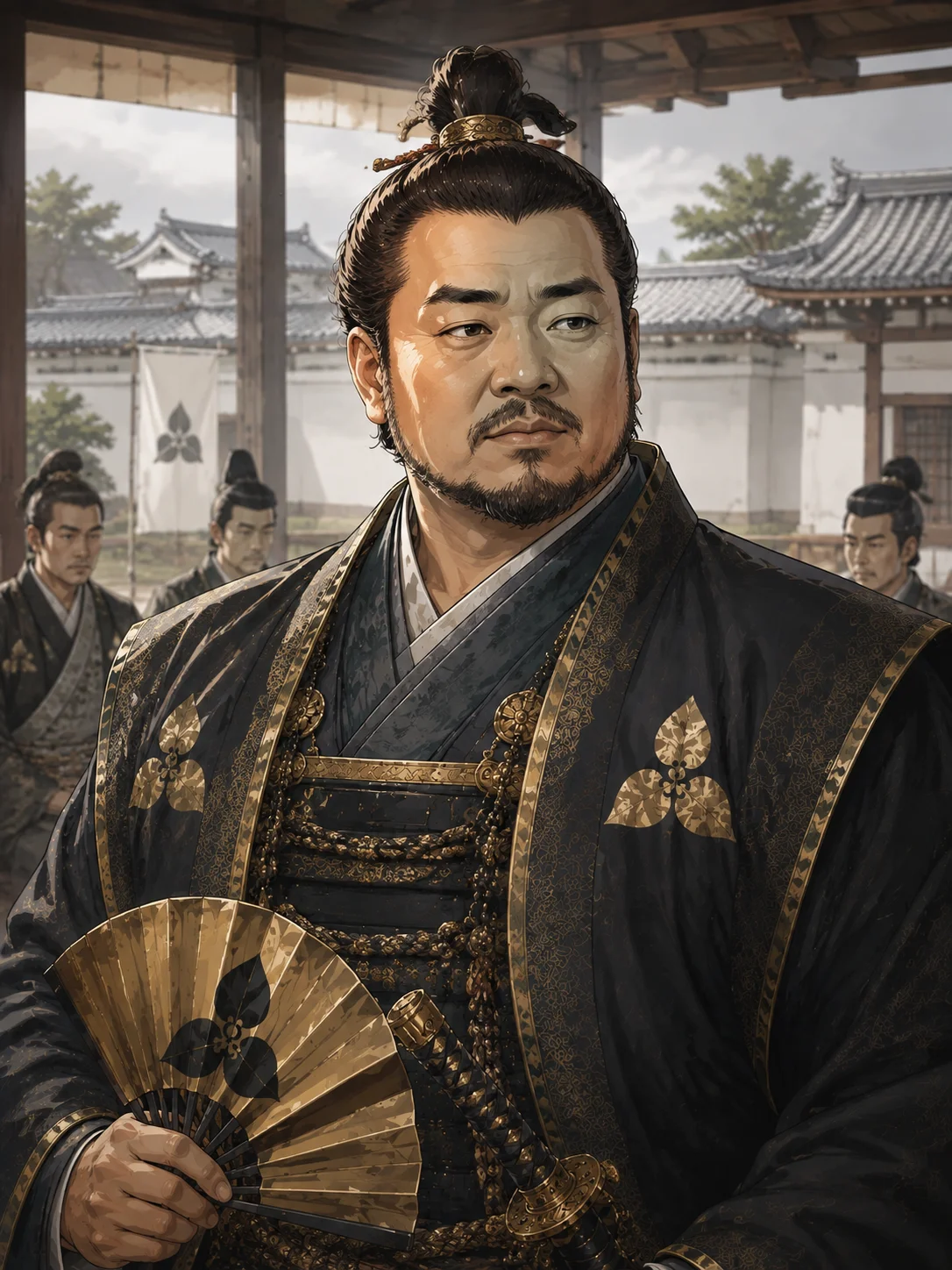
Mōri Terumoto
He inherited the lands his grandfather united, but often lets others move him. Through him, one sees how a lord crushed by reputation can erode his house through hesitation and luck.
Life
Commander-in-Chief of the Western Army
Ambition
Preserve the Mōri’s two-river system, keep its western domain peaceful, and protect the family name.
His grandfather Motonari left him the warning, “Do not compete for the realm.” As Nobunaga and then Hideyoshi rose, Terumoto’s duty was to deliberate with his two uncles, the Kikkawa and Kobayakawa, and preserve the Mōri family line.
Raised as western commander at Sekigahara, if he stays trapped in Osaka Castle while the army loses, the Mōri face confiscation and extinction.
- Mitsunari and Ankokuji Ekei maneuver to make him western commander
- Loss of leadership after Takakage and Motoharu die
- Ieyasu’s severe reduction of the Mōri domain
Character and convictions
Motonari’s “three arrows” teaching and the prestige of the Mōri house.
The helplessness of staying in Osaka while the army loses at Sekigahara and surrendering most of his lands.
His lifelong affection and dependence on his uncle Kobayakawa Takakage.
Disobeying his grandfather through reckless action and endangering the Mōri line.
Historical path
Final chapter
the 27th day of the 4th month, Kan'ei 2 (1625), aged 73He built Hagi Castle and laid the foundations of the Chōshū domain. Retired under the name Sōshū, he died at his residence in Hagi on the 27th day of the 4th month, Kan'ei 2 (1625), aged 73.
“Though he never wished to rule the realm, he was made commander-in-chief of the Western Army and lost two-thirds of his lands. Yet the Chōshū territory into which he was confined became, 260 years later, the force that helped overthrow the Tokugawa shogunate.”