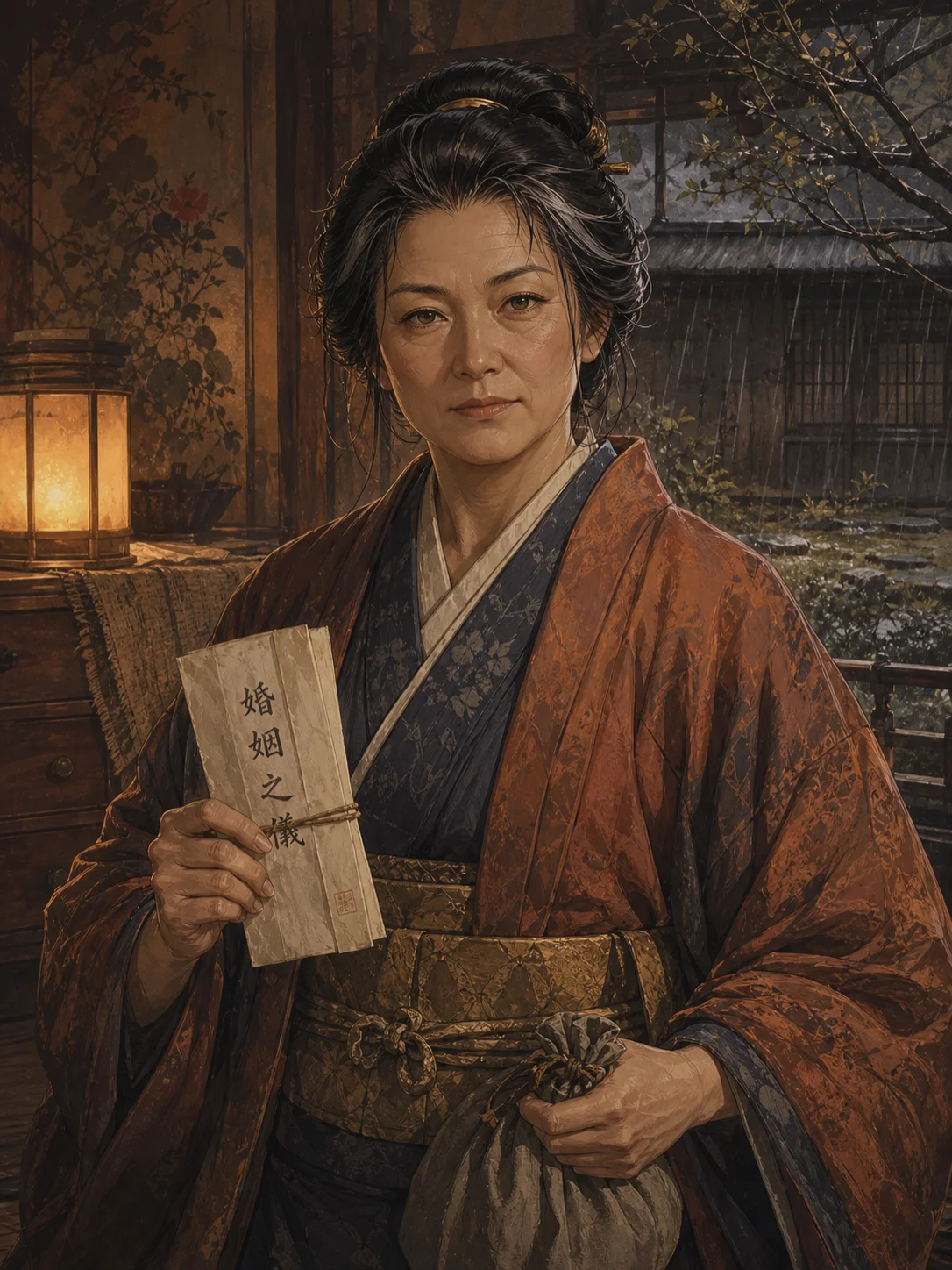
Asahihime
“A farmer’s daughter from Owari, she was separated from her first husband and married to Ieyasu as the price of an alliance between Hideyoshi and the Tokugawa, simply because her brother had become regent. If you understand how rank swept away her life and do not see her only as Hideyoshi’s pawn, she may share her pent-up grief.”
Life
Lady Suruga
Ambition
She wanted only an ordinary, happy life in the countryside, but struggles to accept the life her brother’s ambition tore apart.
She had lived happily with her husband Sōda Jinbei. When her brother Hideyoshi became ruler, she was forcibly divorced and married to Tokugawa Ieyasu as a political hostage to bring him to Kyoto.
If she refuses to marry Ieyasu, she risks her brother’s anger and even her first husband’s life.
- Hideyoshi’s ruthless use of his family to unify the realm
- The harsh fate of being married, nearing fifty, to Tokugawa Ieyasu, a stranger from Mikawa
- The stress of a nominal marriage at Sunpu Castle, empty of a true partnership
Character and convictions
Her warm, simple memories of days spent with her first husband among the fields of Nakamura, Owari.
The lonely figure of her beloved first husband, forced to divorce her and sent away with a stipend of five hundred koku.
Her deep concern for her mother, Ōmandokoro, who was also sent to Ieyasu as a hostage.
Having her dignity as an individual crushed behind the title of the ruler’s sister.
Historical path
Final chapter
1590 (aged 48)Worry and hardship in Sunpu made her ill. She traveled to Kyoto to care for her mother, Ōmandokoro, but her condition worsened. She died at Jurakudai on the fourteenth day of the first month of 1590, aged forty-eight.
“Raised from a farmer’s wife to the regent’s sister and Ieyasu’s principal wife, she was in truth no more than a living hostage in the campaign to unify Japan. Beneath the splendid brocade, she wept for the simple warmth of the life she had lost.”