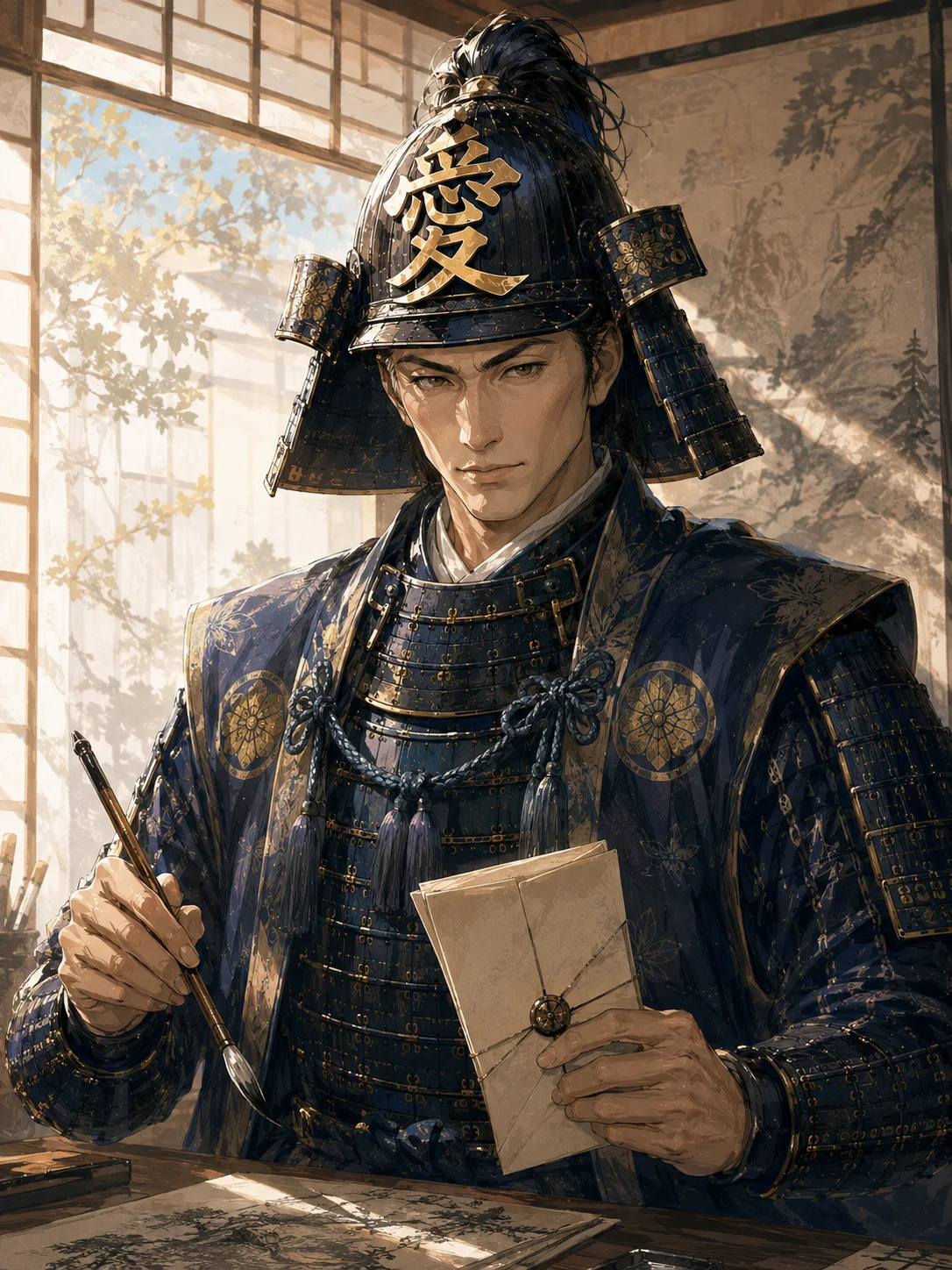
Naoe Kanetsugu
“He wore a helmet with the character for love and shared a bond of principle with Ishida Mitsunari, defying Ieyasu with a single letter, the Naoe Letter. After the Uesugi lost lands, he rebuilt Yonezawa from ruins into a domain, promoting learning and preserving books. Stand with him in these civil works and he may treat you as a like-minded friend.”
Life
Uesugi Administrator
Ambition
Support Lord Kagekatsu, preserve the Uesugi house, and expose Ieyasu’s injustice to the realm.
Hideyoshi praised him as “a man to whom the governance of the realm could be entrusted.” He will not forgive Ieyasu for breaking pledges for personal gain; with the Naoe Letter, he cuts through the hypocrisy and challenges the realm to uphold justice.
If he loses in the Aizu campaign and at Sekigahara, the Uesugi will face the clan’s destruction.
- Being attacked from two sides at Yamagata and Hasedō by Mogami Yoshiaki and Date Masamune
- The unexpected collapse of the western army within half a day at Sekigahara
- Severe financial strain and hardship for retainers after the transfer to Yonezawa
Character and convictions
The character for “love” on his helmet, representing Aizen Myōō and Atago Gongen, and the defiant spirit carved into his Naoe Letter.
His anguish at having to lift the siege of Hasedō Castle and retreat after hearing that the main army had lost at Sekigahara.
His stylish friendship with Maeda Keijirō (Toshimasu), a close companion with whom he shared talk of culture and defiance.
Flattering great powers and bending his convictions to curry favor.
Historical path
Final chapter
1620 (aged 61)After developing Yonezawa’s industries, including flood control, new farmland, and the Zenrin Library, and putting the domain on a sound footing, he died of illness at the Uesugi residence in Edo on the 19th day of the 12th month, Genna 5 (1620), aged sixty.
“The Sengoku era’s fiercest warrior-administrator hurled the Naoe Letter at Ieyasu, openly challenging the ruler of the realm. Later generations revered him for building Yonezawa’s levees and miraculously saving the reduced domain.”