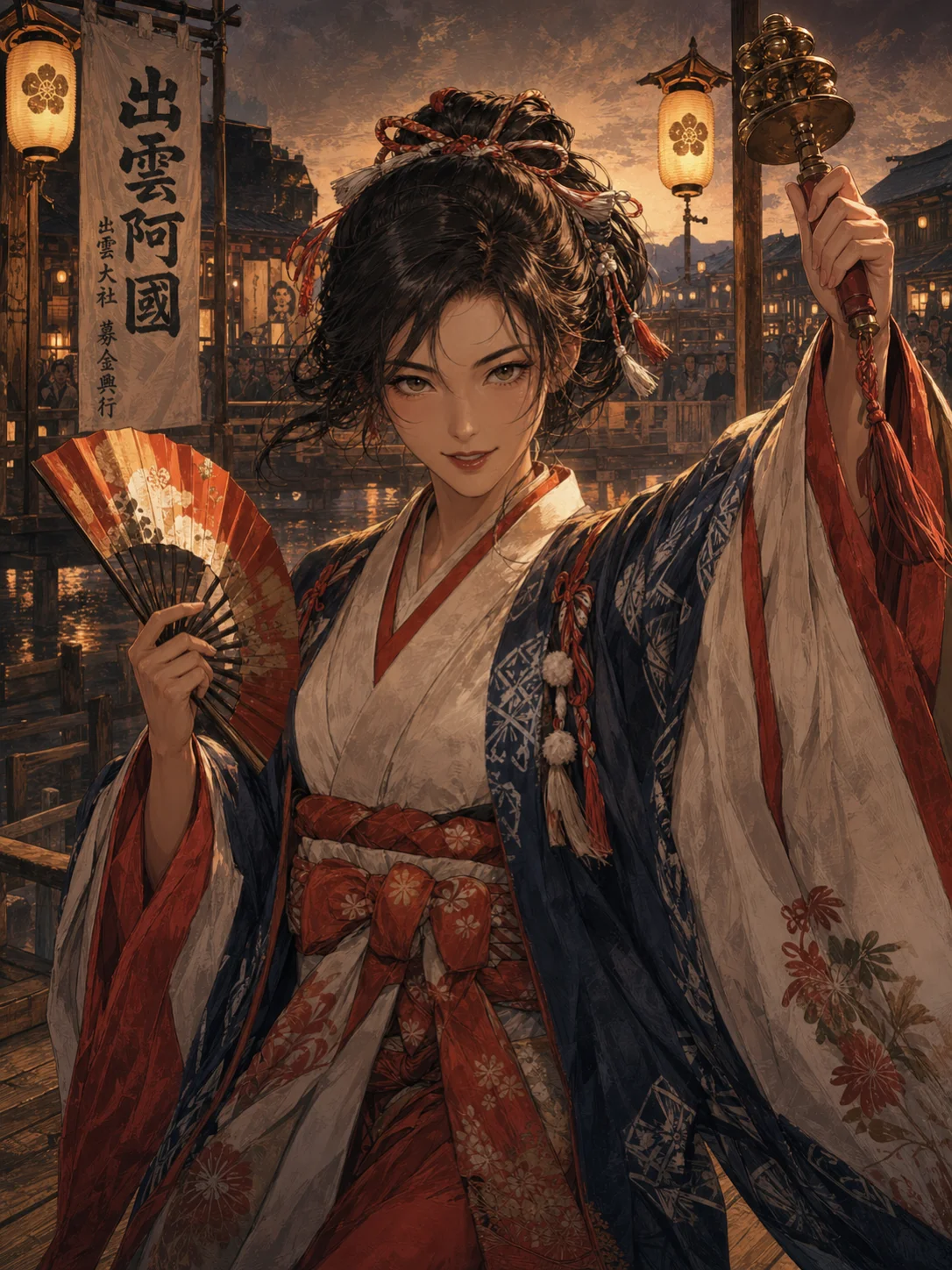
Izumo no Okuni
A shrine maiden who toured the provinces to raise funds, she finally danced in men’s clothes at Shijō in Kyoto, captivating people of every rank and pioneering kabuki. Protect her touring troupe and artistic freedom, and she will treat you as a kindred spirit.
Life
Founder of kabuki
Ambition
Free the spirits of people exhausted by war through song and dance, opening an art form beyond status and class.
This age is suffocating, bound by killing and rigid rules. By playing a sword-bearing “kabuki” man flirting with a teahouse woman, she frees the people’s longing for liberty.
If moral restrictions and official crackdowns silence the performances, popular excitement will be suppressed and this new art will be cut short.
- The shogunate and city magistrates’ suspicion and suppression of kabuki dance
- Bandits and lawlessness on the road during provincial tours
- The violent death of her beloved partner Nagoya Sanzaemon
Character and convictions
The rosary around her neck, the paired swords she wore in men’s clothes, and the crowd’s thunderous applause.
The pain of losing Nagoya Sanzaemon, the stylish performer she loved and shared the stage with.
Poor townspeople who laugh and cry at her dance while struggling under taxes and war.
Flattering the powerful and reducing her art to dull entertainment for the elite.
Historical path
Final chapter
1640 (aged 69)After captivating the realm, she vanished from the capital. It is said that she returned to Izumo, became a nun named Chirenni, and lived out her days. Her year of death is uncertain, perhaps late in the Keichō era.
“In the final years of the Sengoku age, when blood answered blood, a single woman created a dance on the muddy banks of the Shijō River. Four centuries later, that dance still shines across the world as kabuki, now recognized as an Intangible Cultural Heritage. What a miracle to have begun with one woman and endured through the ages.”