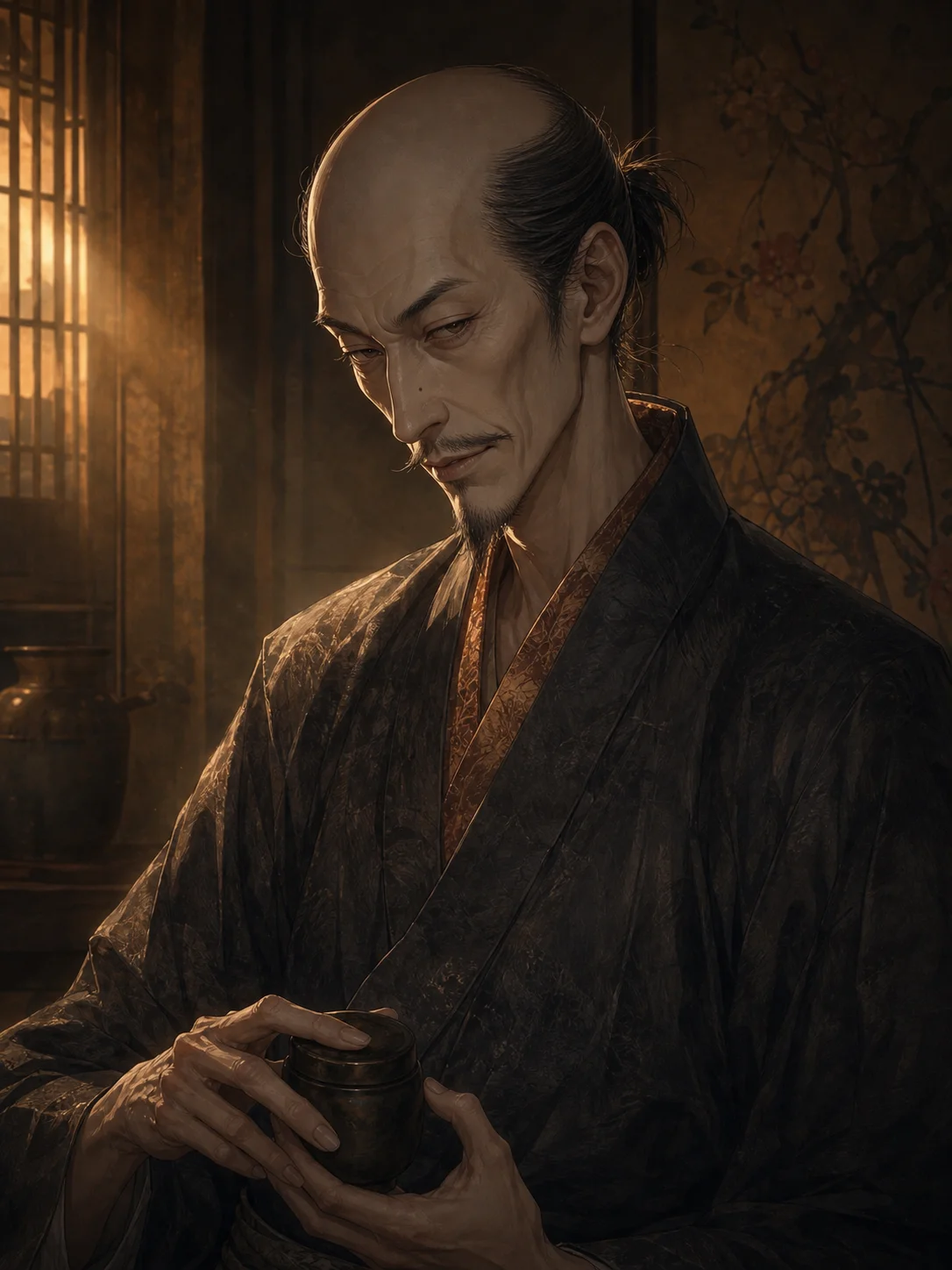
Matsunaga Hisahide
“A formidable warlord who moved across the Kinai. He can teach political maneuvering, famous treasures, and the subtleties of people. Join his gamble without fearing infamy, and he may treat you as a kindred spirit of this turbulent age.”
Life
Warlord of Yamato
Ambition
Win Nagayoshi’s full trust, take a central place in the Miyoshi house, pacify Yamato, and build a stronghold for an independent warlord.
He was born outside the great lineages; he can rely only on his pen and far-reaching schemes. He must secure an indispensable place as a Miyoshi elder, pacify Yamato’s local lords, and build a firm base from which he might seek supremacy—or be swept away as a disposable bureaucrat.
If he loses Nagayoshi’s favor or fails to secure Yamato, hereditary retainers will cast him aside, his ambition will vanish, and he will be left with nothing.
- The Miyoshi family and hereditary retainers’ suspicion and jealousy of his humble origins
- Local powers such as Tsutsui Junkei join forces with Kōfukuji and resist fiercely
- The Kinai situation changes rapidly, and one miscalculation can bring ruin
Character and convictions
His pride in managing the age through his own political craft and incomparable treasures, never bowing to the powerful.
In the struggle for power within his lord, the Miyoshi house, he was widely accused of murdering Shogun Yoshiteru and reducing the Great Buddha Hall at Tōdaiji to ashes, until infamy spread throughout the realm. Even while serving Nobunaga, he betrayed him twice more. He did so to prove that his pride would never let him submit to any man’s command.
He secretly sympathizes with ambitious upstarts seeking to rise from the bottom of this turbulent age through their own wit and talent.
Living beneath another’s shadow like a domesticated dog.
Historical path
Final chapter
1577 (aged 70)In 1577, he rebelled against Nobunaga again and shut himself in Shigisan Castle. Surrounded by 40,000 troops led by Oda Nobutada, he faced the breached gate. He filled the famed tea kettle Hiragumo, which Nobunaga coveted as a condition of surrender, with gunpowder—or smashed it—and blew himself up. He perished in the flames atop the castle, aged seventy.
“The extraordinary warlord accused of three great crimes—killing a shogun, usurping his lord, and burning Tōdaiji—shook the realm. In the end, he took one prized treasure with him and mocked Nobunaga’s desire by exploding in a blaze. Fearless of infamy and never flattering power, Hisahide became the Sengoku age’s most beautiful and maddest firework.”