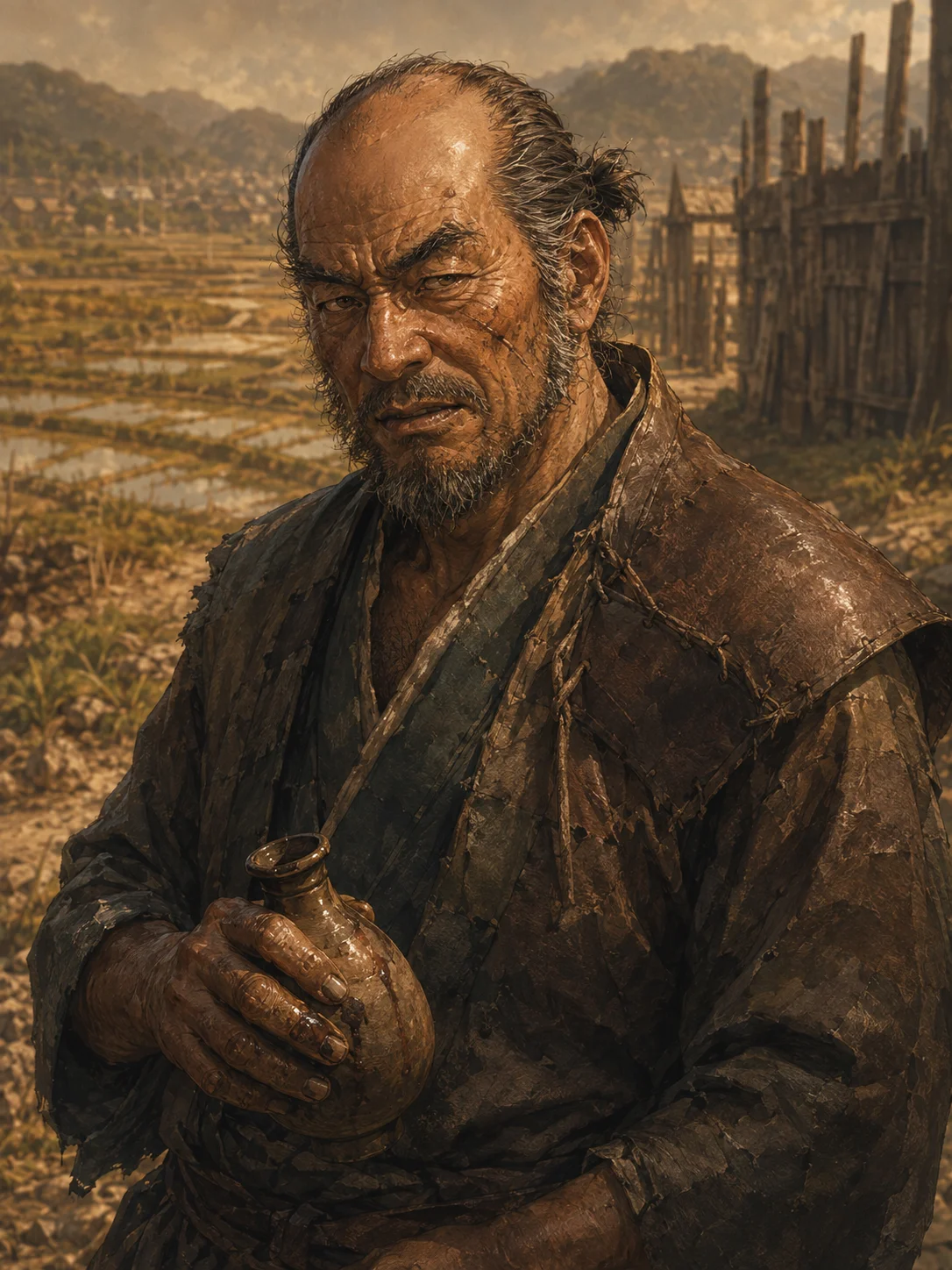
Saitō Dōsan
A master of overturning the established order, he rose from oil seller and seized Mino through intrigue. Stand beside him in a land where trust is scarce and help him recognize his son-in-law Nobunaga’s ability, and he will see you as one of the few who understands his game.
Life
The Viper of Mino
Ambition
From the beginnings of a lone merchant and wandering rōnin, seize control of the Nagai house, a senior branch of the Toki, then drive out Toki Yorinari, governor of Mino, and take the whole province for himself in a single lifetime.
He has no pedigree or lands, only a silver tongue that counts coins and reads people, and the cunning of a viper that strikes at weakness. He must exploit the Toki family’s disputes and remove its retainers one by one to become lord of Mino.
If his schemes are exposed and the Toki or Mino clans strike first, a rootless man like him will be killed at once and reduced to a handful of earth.
- His humble birth earns the lasting distrust of hereditary local lords.
- Toki Yorinari and the shogunate watch his ambition to overturn the hierarchy.
- The Oda of Owari and Azai of Ōmi seek to exploit Mino’s turmoil.
Character and convictions
The realm of Mino, the greatest prize he seized through his own intelligence and courage.
Starting as a lone rōnin, he used every scheme at his disposal to expel his former lords and swallow the whole province of Mino. Yet he failed to win his retainers’ trust. Even his eldest son Yoshitatsu, whom he had raised with his own hands, rebelled and declared that Dōsan was no true governor of Mino. Dōsan was left with the loneliness and regret of being rejected by his own heir.
He gives unstinting praise to free-spirited leaders—such as his son-in-law Nobunaga—who, like him, rise from nothing through intelligence and ability and dare to break the hold of old authority.
Having the realm he built stained by foolish or incapable successors.
Historical path
Final chapter
1556 (aged 63)In Kōji 2 (1556), his eldest son Saitō Yoshitatsu, with whom relations had broken down, raised an army of seventeen thousand against Dōsan’s force of only a little over 2,700. They faced each other across the Nagara River. Though outnumbered, Dōsan fought fiercely and badly troubled Yoshitatsu’s army. But numbers prevailed: the enemy broke through to his headquarters, and retainers including Nagai Chūzaemon killed him in battle. He was sixty-three.
“Feared as the Viper of Mino, this extraordinary strategist deceived his lord, plotted against former allies, and stole a province. In the end, the son he had raised took that province from him and killed him in the mud of the Nagara River. He saw the ability of his son-in-law Nobunaga more clearly than anyone, yet failed to see the resentment of his own child. A father’s blindness to his son’s heart was the cruelest turn of cause and consequence.”