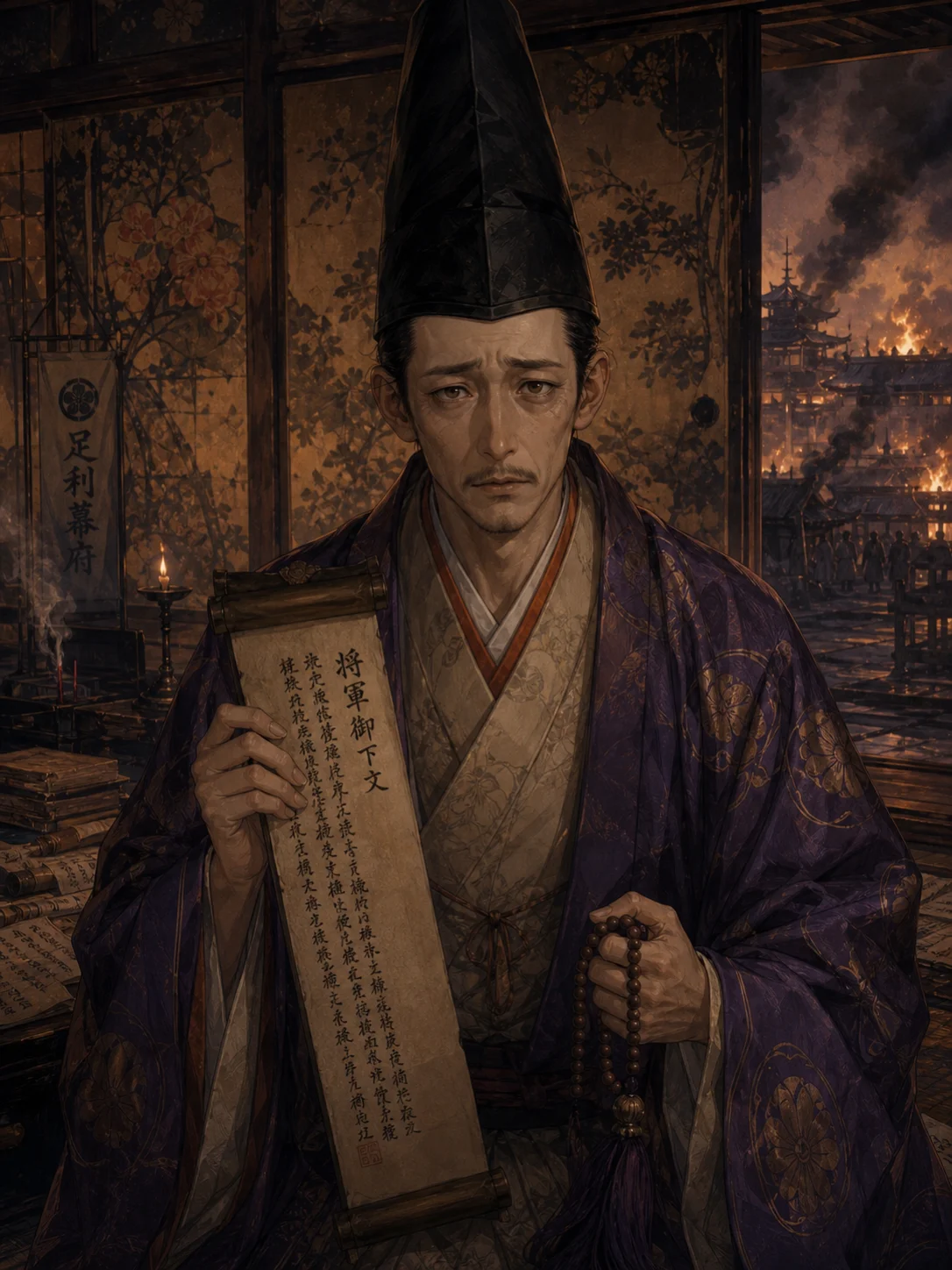
Ashikaga Yoshiaki
The last shogun carried the legitimacy of two centuries of the Muromachi order. He can connect the court and the great lords through authority and personal ties. Help him labor to restore the shogunate, and he will treat you like family.
Life
Fifteenth Shogun
Ambition
Win support from the great lords, enter Kyoto, become the fifteenth shogun, and restore the Ashikaga house’s authority and power.
During the Eiroku Incident, he lost his brother Yoshiteru to the blades of the Miyoshi and Matsunaga, then barely escaped confinement himself. With help from the Asakura of Echizen and Oda of Mino, he had to reach Kyoto, displace Yoshihide, the Miyoshi faction’s puppet, and inherit the shogun’s rightful office—or the 200-year Ashikaga shogunate would go dark.
Without a lord willing to raise troops for him, he may remain a wandering guest while a Miyoshi puppet rules the realm, ending Muromachi legitimacy and destabilizing the order between court and warrior.
- Asakura Yoshikage of Echizen hesitates to march on Kyoto, wasting the opportunity
- The Miyoshi Triumvirate dominates Kinai after installing Ashikaga Yoshiaki
- He lacks his own army and funds, leaving him at the mercy of each lord’s agenda
Character and convictions
The Ashikaga shoguns’ inherited legitimacy and the authority to command the lords of the realm.
After Nobunaga’s force brought him to Kyoto and made him shogun, Nobunaga imposed five articles that made him feel like a mere “banner for Tenka Fubu.” He then struggled to restore true shogunal authority by joining Takeda, Asakura, Azai, and Honganji in a coalition against Nobunaga.
He feels deep sympathy for nobles whose pride is crushed as they are tossed between the protection and pressure of powerful men.
Accepting life as a puppet shogun in another’s hands and disgracing the Ashikaga name.
Historical path
Final chapter
1582 (aged 49)Nobunaga drove him from Kyoto, and the Muromachi shogunate effectively ended. He fled to Tomo in Bingo under Mōri protection, but could not return even after the Honnōji Incident. Under Hideyoshi, he received 10,000 koku at Makita in Yamashiro, took Buddhist vows, and called himself Shōzan. His old illness worsened in Osaka, where he died quietly despite treatment, aged 61.
The shogun who longed throughout his life to restore the Muromachi shogunate and kept sending imperial-style letters to the great lords never imagined that opposing Nobunaga—the man he had relied on most—would end the shogunate of two centuries by his own hand. He died grieving the irony that his drive to save it had brought about its fall.