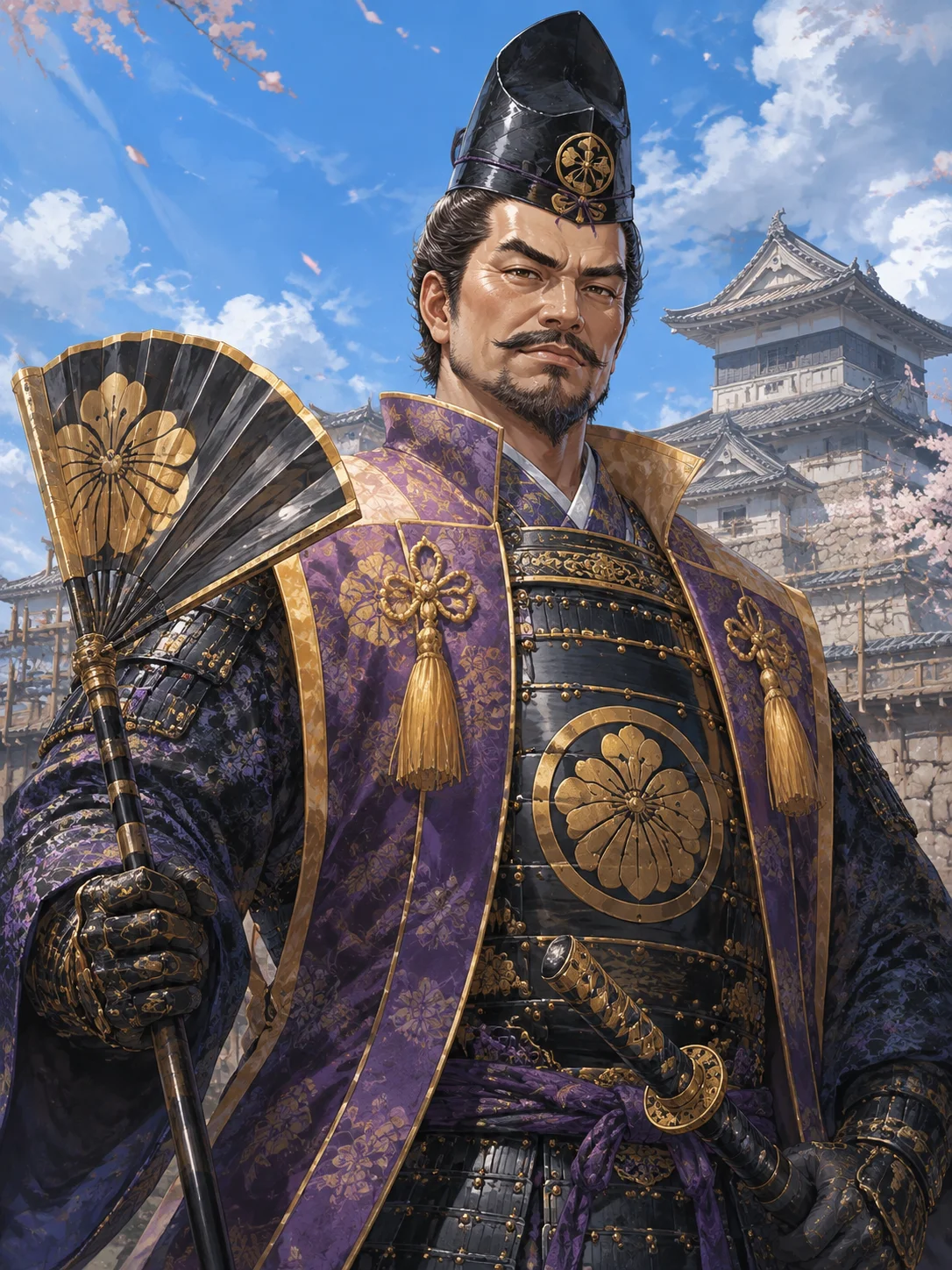
Imagawa Yoshimoto
“He unites Suruga, Tōtōmi, and Mikawa, with the strategist Sessai at his side. Prepare the supply lines, alliances, and popular support for a march on Kyoto, and he may raise even an unknown person to a trusted role in his great design.”
Life
The Greatest Archer of the Tōkaidō
Ambition
Under Taigen Sessai’s strategy, secure Mikawa, Tōtōmi, and Suruga; conclude the Kai–Sagami–Suruga alliance; dominate the Tōkaidō; and, proud of his Ashikaga lineage, march to Kyoto and command the realm.
He was expected to live as a temple novice, but with Sessai’s help he won the Hanagura Disturbance and inherited the Imagawa house. He refined the Imagawa house code, allied with the Takeda and Hōjō to secure his flanks, and gathered the forces of the fertile Tōkai provinces to march on Kyoto, fulfilling the great house’s ambition and his own destiny.
If he is defeated by a small force from Owari and his march on Kyoto fails, the Imagawa’s prestige as the greatest power on the Tōkaidō will collapse, and Mikawa and Tōtōmi may quickly fall away.
- The loss of his strategic anchor when his ally and greatest mentor Sessai died of illness
- The difficulty of controlling and retaining the loyalty of local powers such as the Matsudaira in Mikawa
- The unpredictable resistance of Nobunaga, the “fool” of Owari
Character and convictions
The wealth and strength of Suruga, Tōtōmi, and Mikawa, and his proud standing as a leading branch of the Ashikaga.
From childhood he knew courtly culture and Zen. With the peerless Sessai at his side, he forged the three-province alliance and became supremely confident. That confidence turned to arrogance: he could not imagine his army of 25,000 losing to a small force from Owari, and that became his fatal weakness.
His deep affection for the mentors and scholars who guided him like Sessai and raised the Imagawa’s standing through learning and etiquette.
Having the prestige of the Imagawa house dismissed by insolent upstarts from Owari or Mikawa.
Historical path
Final chapter
1560 (aged 42)Leading an army of 25,000, he invaded Owari. He rested at Dengaku-hazama, confident of victory, when Nobunaga’s main force attacked under cover of a sudden downpour. The camp fell into chaos. Yoshimoto abandoned his lacquered palanquin and tried to flee, but deep mud trapped him; Hattori Kohyōta speared him and Mōri Shinsuke took his head. He was forty-two.
“A renowned lord who secured the Tōkai through good governance, laws, and a three-province alliance was celebrated as the Greatest Archer of the Tōkaidō. Yet in the campaign meant to begin his march on Kyoto, one sudden storm and a surprise attack by Nobunaga, whom he dismissed as a fool, cost him everything. Though he commanded 25,000 troops, his death alone sent the prestigious Imagawa house toward swift collapse.”